
Textbook · English
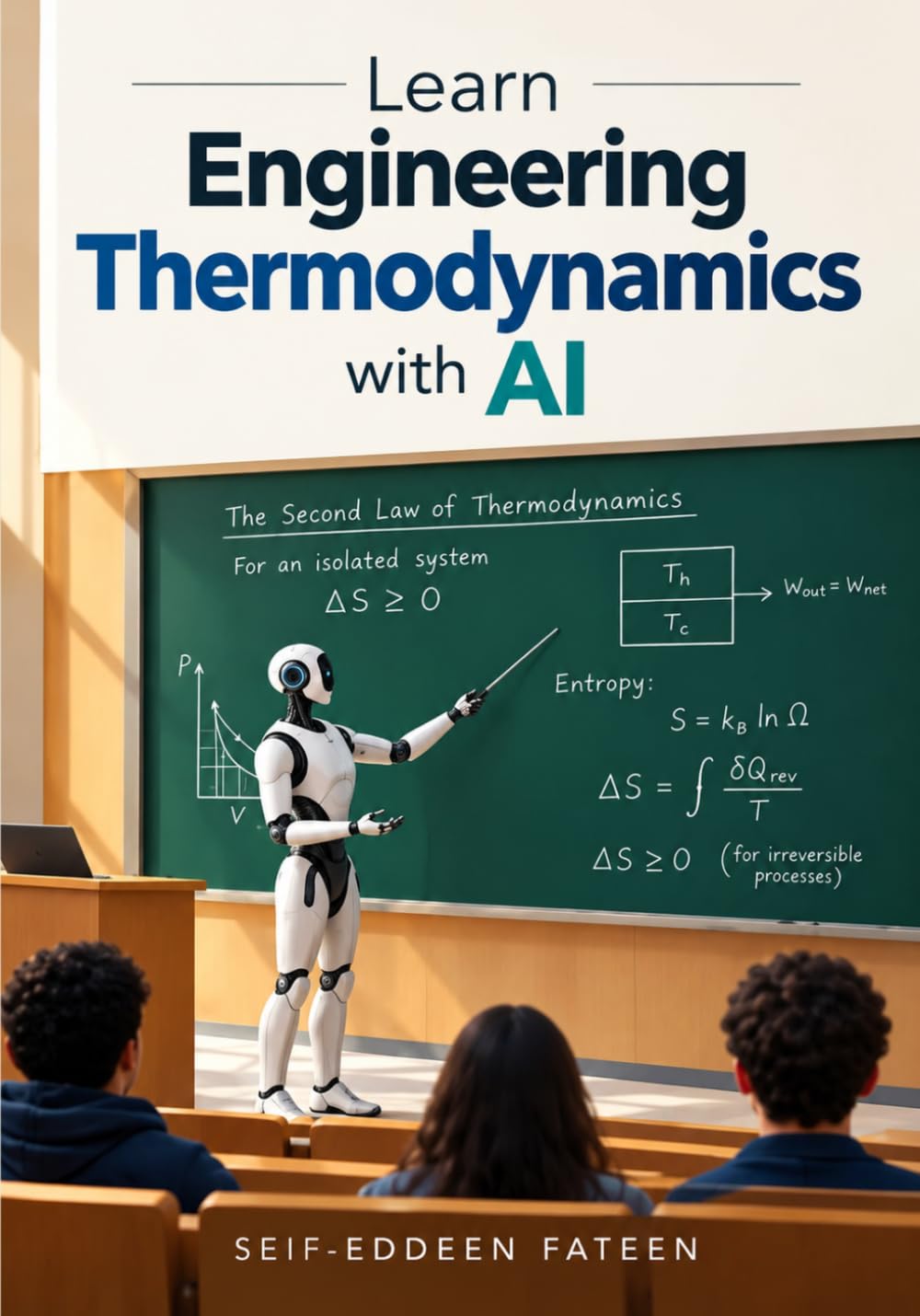
Learn Engineering Thermodynamics with AI
Your students already use AI. This textbook teaches them to use it without losing the physics.
Learn Engineering Thermodynamics with AI is a complete first course in engineering thermodynamics, written for a classroom where a chatbot can return a confident, fluent, and sometimes wrong answer in seconds. It covers everything a first course needs, then carries on into the mechanical and chemical applications engineers use in practice. Each chapter also teaches a second skill: working with AI so that your own understanding grows instead of being replaced.
Four defined roles for AI
AI never appears as a vague instruction to “use it responsibly.” It always works in one of four roles:
- Tutor: withholds the answer until you have attempted the reasoning.
- Verifier: finds your first mistake without fixing it for you.
- Critic: hunts for invalid assumptions and unit errors.
- Calculator: limited to a narrow, pre-specified numerical task.
Chapters include AI failure cases, where a plausible answer turns out to be technically wrong, and transcripts of students catching a mistake mid-conversation. A prompt protocol, academic integrity guidance, and rules for recording data sources and property libraries complete the method.
What you will learn
- Properties, phase behavior, ideal and real gases, and equations of state.
- The first law for closed systems and control volumes.
- The second law, entropy balances, isentropic efficiency, and exergy.
- Thermodynamic potentials and property relations.
- Steam power, gas turbine, and internal-combustion cycles.
- Refrigeration, heat pumps, refrigerant selection, psychrometrics, and HVAC.
- Mixtures, fugacity, activity coefficients (NRTL and UNIQUAC), and phase equilibrium.
- Reaction equilibrium, Gibbs minimization, combustion, flame temperature, and fuel cells.
Built for learning
- Three running case studies, a reheat steam power plant, an air-source heat pump, and a methane combustion train, return with fixed numbers so you see the same system at greater depth.
- Learning objectives, worked examples, exercises marked by difficulty, and mastery checks for every chapter.
- Integrative projects and a guide to further exploration.
Who it is for: undergraduate engineering students, self-learners, and the instructors preparing them for careers in which AI is part of the job.
About the author: Seif-Eddeen K. Fateen is a Professor of Chemical Engineering at Zewail City of Science and Technology in Egypt. He holds a PhD in Chemical Engineering from MIT and has published more than twenty peer-reviewed papers on applied thermodynamics.